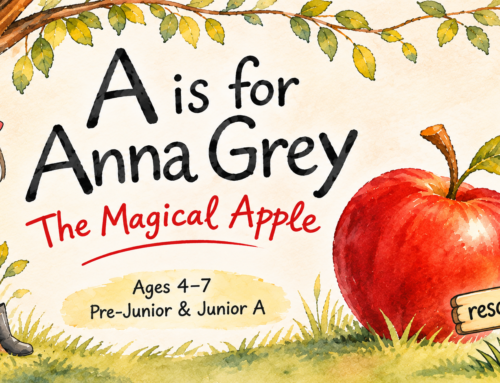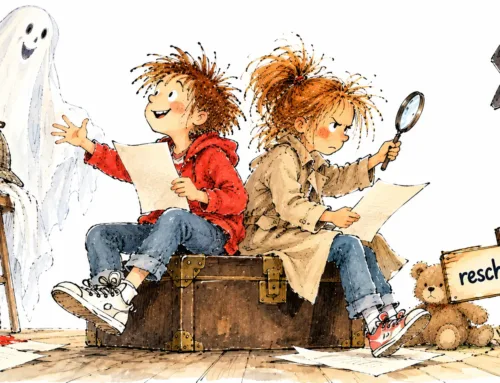
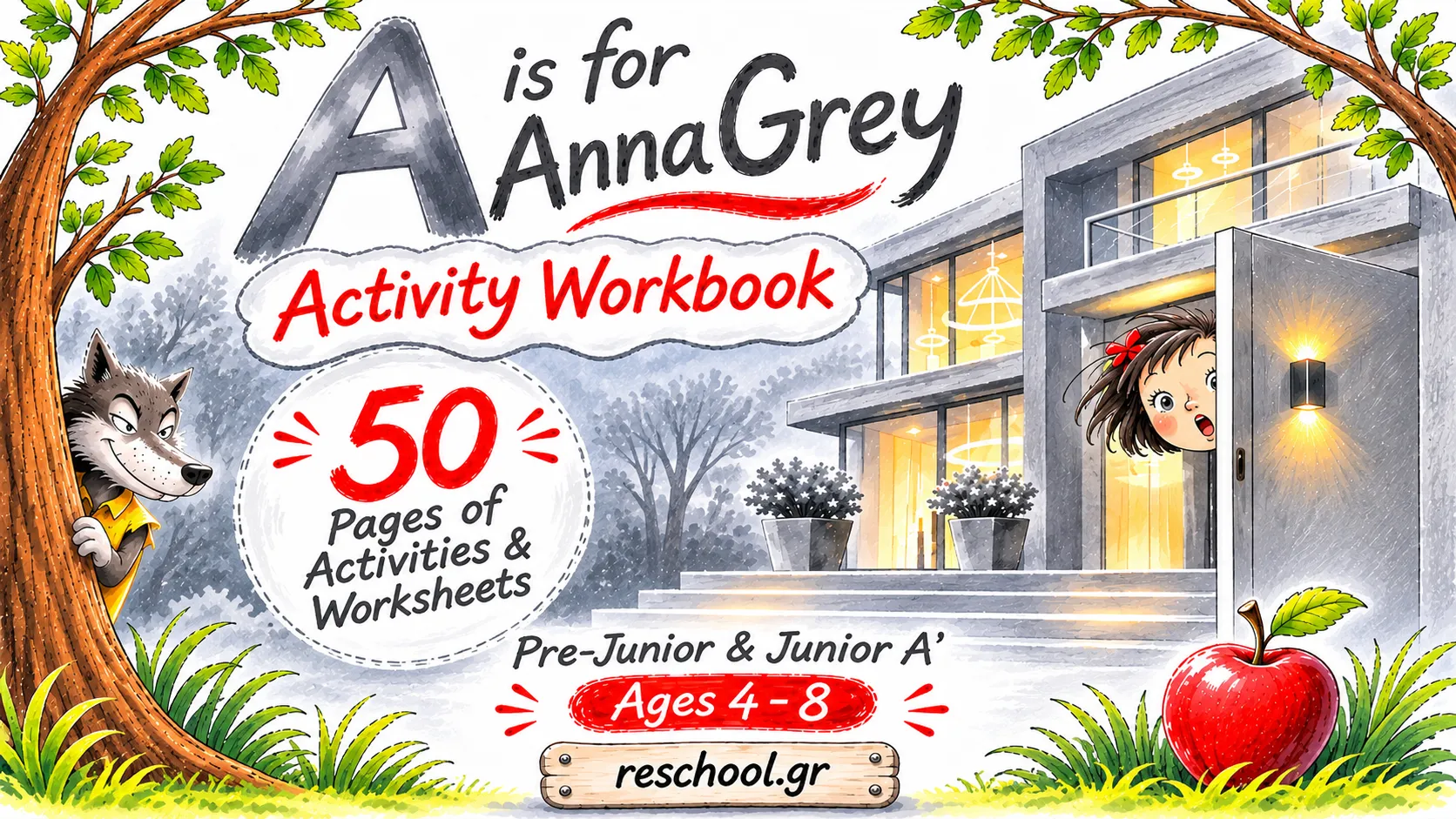
Anna Grey is back, and this time she brings games, masks, puppetry, crafts and dozens of ideas for creative teaching!
A few days ago, I shared with you one of the first stories I wrote for my students, The Magical Apple. Today, it is time to open the door to my classroom a little wider and show you what we can do with children beyond storytelling.
And somehow, I found myself creating:
-
A 50-page Activity Workbook.
-
Two additional printable files for constructing a large theatre stage.
-
A comprehensive video explaining how to make the most of all these resources.
All this for a single letter! The letter Aa! Fortunately, the English alphabet has only 26 letters; otherwise, I have no idea when I would ever get to retire!
Of course, the intention is not to have a five-year-old sit down and complete 50 pages on the letter A. If that were the case, I suspect that by the time we reached the letter B, the child would already have moved to another language school!
I created so many different activities because no two children in my classroom are exactly alike. One child may enjoy drawing, another may love moving around, a third may be fascinated by crafts, and a fourth may eagerly await the moment when I hand them a puppet to perform with.
I wanted teachers to have choices. To be able to select activities according to their students’ ages, abilities, interests and needs.
You do not need to use every single page. Choose the ones that suit the children in front of you.
One of the most interesting challenges in teaching is finding ways to help children encounter the same information repeatedly without feeling that they are constantly doing the same thing. Today, a child recognises a word through a picture. Tomorrow, they try to remember it while playing a game. In the next lesson, they use it during a puppet show, and a little later, they need it to communicate with a classmate. The word remains the same. What changes is the activity and the way the child is encouraged to retrieve and use it.
This is particularly important for learning. We are not simply interested in whether a child can recognise a word when looking at a familiar picture. We want to know whether they can remember it when the picture is no longer in front of them and whether they can use it in a different activity.
Knowledge is like a plant. It does not grow because we pull on it every day to see whether it has become taller. It needs care, time and the right conditions.
When I was little, I had only one doll. Strangely enough, I was never particularly interested in playing with dolls. Whenever I played with that one, however, I usually pretended to be a teacher. The doll was my student, I imagined other students sitting around her, and a wardrobe served as my classroom board. Perhaps that one little doll is responsible for the hundreds of paper puppets I create today!
One of my favourite sections of this educational resource is the printable paper theatre. I have created miniature three-dimensional theatre stages, paper characters, scenery and props so that children can recreate the story and invent adventures of their own.
I particularly enjoy having children work in pairs, with each child having their own miniature stage. This way, instead of having 10 children (or even 20… who knows how many students you have in your classrooms!) waiting for their turn to perform, everyone can participate simultaneously.
I have also included a large printable theatre stage, assembled from eight A4 sheets, which can be used again and again, even with other stories.
And what if you do not have an interactive whiteboard or a screen in your classroom? No problem! Some paper, a pair of scissors, a few clothes pegs, a torch and a generous helping of enthusiasm can create a wonderful little theatrical experience.
I have often noticed that a child who hesitates to answer one of my questions may eagerly rush to help a puppet struggling to remember a word. When the puppet makes a mistake, the child suddenly takes on a different role. They are no longer the student waiting to be assessed, but someone who knows something and can help somebody else. This change of role can reduce the pressure a child feels when asked to speak in front of others.
And, of course, Anna Grey has my permission to make as many mistakes as she likes. Sometimes, I even tell her exactly which mistakes to make!
The material also includes printable masks, allowing children not only to manipulate the paper characters but also to become the characters themselves. You could even organise a little theatrical performance and invite their parents.
Those of you who are familiar with my work know how important it is to me to create educational resources that nurture both knowledge and children’s emotional well-being. That is why, alongside activities focusing on the letter Aa and vocabulary,you will find opportunities to talk to children about their feelings, dreams, difficulties, kindness and acceptance of differences.
I do not want Anna Grey to be simply a teaching aid that helps children remember a letter. I want her to be a character who encourages them to think, express themselves and develop a better understanding of themselves and the people around them.
When I completed the 50 pages, I realised that there were still so many things I wanted to explain to teachers. Little details, alternative ways of using the activities, ideas born in the classroom and pedagogical considerations that I believe are important.
So, I decided to create a comprehensive recorded teacher training video, in which I present the material page by page and personally explain how you can use it.
I will talk to you about:
-
Different age groups.
-
Children who are not yet ready to write.
-
Alternative activities.
-
Puppetry.
-
The aesthetics of educational resources.
-
Memory and the importance of active participation.
You will also hear about my personal classroom experiences and discover many additional ideas that are not included in the 50 pages. You can watch the video at your own pace, pause whenever you like, take notes and return to it whenever you need a fresh idea. By the end, of course, you will probably understand why I find it so difficult to say, “And now, let’s wrap things up!” during my seminars.
-
50 pages of illustrated educational resources in PDF format.
-
Printable worksheets.
-
Letter recognition and vocabulary practice games.
-
Movement, memory and creative expression activities.
-
Paper characters and three-dimensional theatre stages.
-
Printable masks and crafts.
-
Bookmarks and little keepsakes for children.
-
A large printable theatre stage on eight additional A4 sheets.
-
A comprehensive recorded teacher training video.
The material is primarily designed for children aged 4–8, at Pre-Junior and Junior A levels.
The Activity Workbook is the companion educational resource to the storybook Aa is for Anna Grey – The Magical Apple.
If you have already purchased the Storybook, I recommend combining it with the Activity Workbook. Likewise, if you discover the Activity Workbook first, I encourage you to explore the storybook as well. The two resources complement each other, but they can also be used independently.
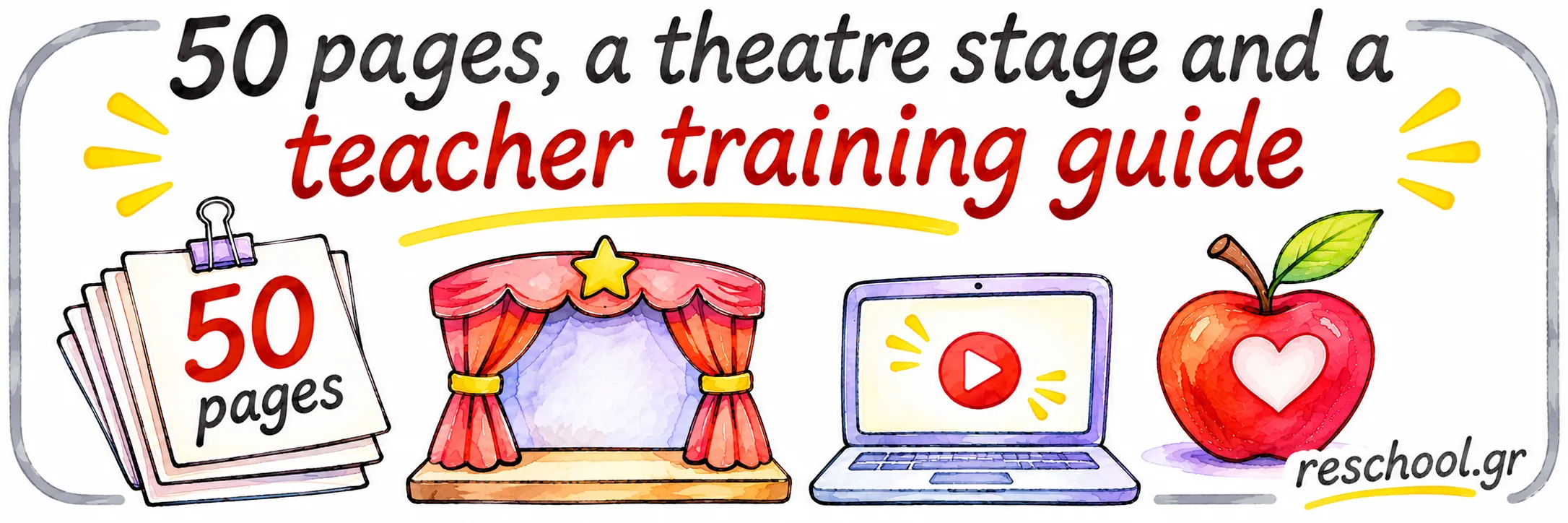
The Aa is for Anna Grey – Activity Workbook & Creative Teaching Kit, together with the additional printable files for the large theatre stage and the comprehensive teacher training video, is available through RESCHOOL for €15.
I would love for you to send me a photograph of the miniature theatre stages you have created or share a funny little story about something that happened when Anna Grey visited your classroom.
My greatest joy is knowing that something I originally created for my own students can bring wonderful learning experiences to yours, too.
Discover Aa is for Anna Grey – Activity Workbook & Creative Teaching Kit.

RESCHOOL – Teach Like an Artist
Sophia Papadeli