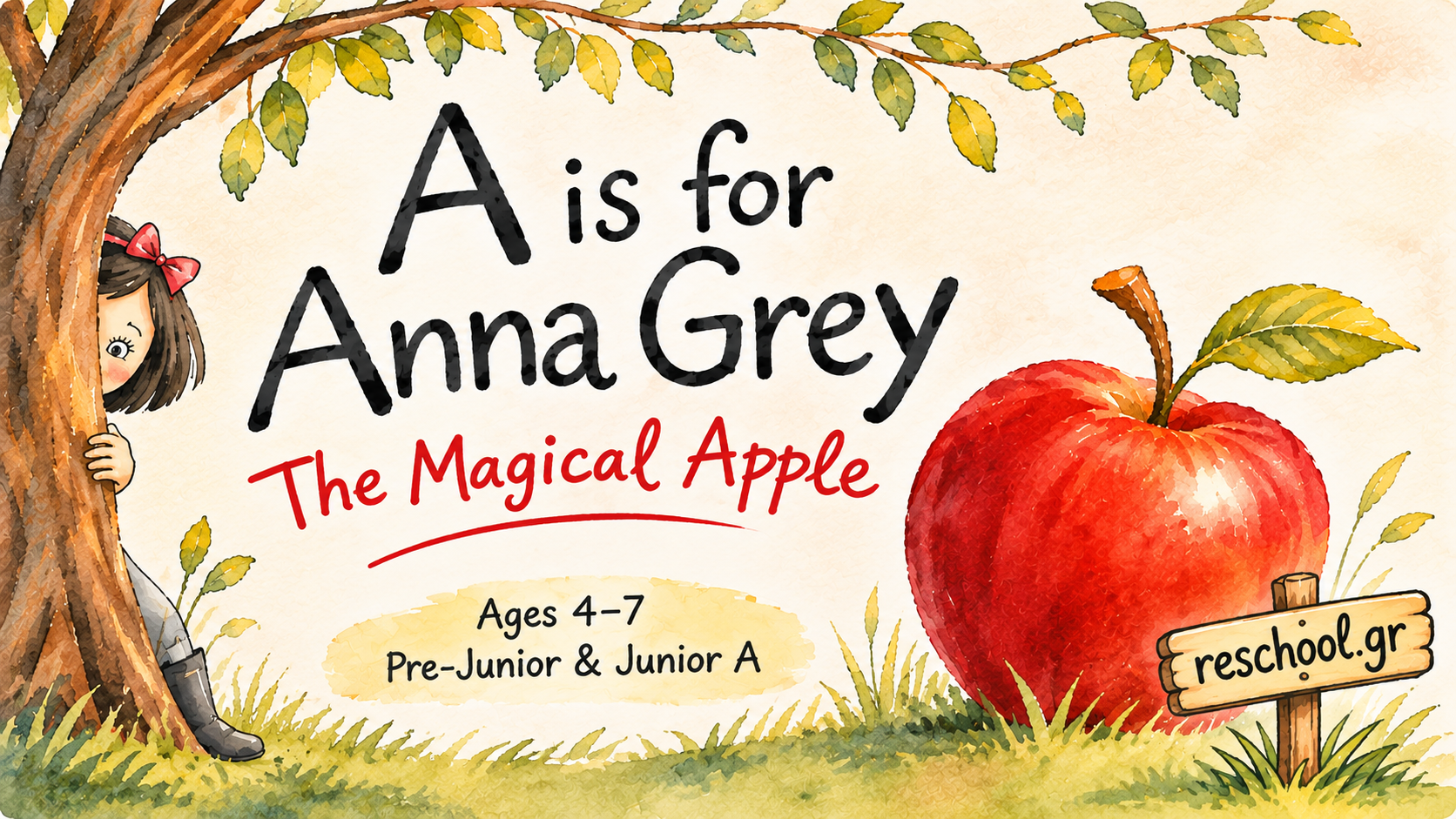
One of my earliest alphabet stories, loved by generations of my students, is now available to English teachers around the world.
I have been teaching English for more than forty years, and some of the most precious things I have created during that time have never travelled beyond the walls of my own school. They have lived in my classrooms, changed and improved through years of teaching, and become so familiar to my students and me that I can hardly imagine our lessons without them.
Anna Grey is one of those creations, and today I am feeling particularly emotional because, for the first time, I am sharing her complete illustrated fairy tale, The Magical Apple, with teachers and families around the world.
I wrote this story many years ago. Since then, it has been part of the very first English lessons of countless young learners at my language school in Greece. I have watched children become fascinated by Anna, eagerly anticipate the next scene, imitate the characters, remember their words and recognise the letter Aa through the associations we create together. Year after year, the story has remained one of my most successful and enjoyable ways of introducing children to the English alphabet.
And now, after keeping this little treasure in my classrooms for so long, I have decided that it is time for Anna Grey to meet other children.
How My Alphabet Became a World of Characters
Many years ago, I started wondering how I could make letters easier for young children to understand and remember, particularly those who found it difficult to connect unfamiliar shapes with sounds. I wanted to give them something meaningful to hold on to, something they could recognise and recall long after the lesson had ended.
That was when I began creating my own alphabet characters.
I drew all 26 letters of the English alphabet as individual personalities, giving each of them a first name, a surname, a distinctive appearance, particular habits and a recognisable way of behaving. I spent a great deal of time thinking about their characteristics because every detail had a purpose. I wanted the children to understand who these characters were and why they behaved as they did.
Some are generous and friendly, while others are stubborn, mischievous or rather difficult to get along with. They have favourite companions, form friendships and occasionally change their behaviour when certain letters appear beside them. I find this particularly amusing because it reminds me so much of human relationships. We all behave a little differently depending on whom we are with, and my alphabet characters are much the same.
Eventually, I had created 26 original fairy tales, one for each letter. As the characters developed, I began bringing them together in new adventures, using their personalities and relationships to explain letter combinations, pronunciation patterns and other features of English.
Over time, these stories grew into an entire teaching world that continues to develop as my students progress.
Anna Grey was one of the first characters I created, and she has held a special place in my classroom ever since.
Some of You Have Already Met Anna Grey
If you have attended one of my teacher-training seminars, you may already be familiar with Anna. I have introduced her character to many teachers over the years, shared illustrations I created and demonstrated some of the teaching techniques connected with her appearance and behaviour.
I have also shared educational activities based on the character, and it has always been a pleasure to see other teachers become interested in the possibilities of this approach.
Her complete fairy tale, however, has remained exclusively within my school.
The Magical Apple has been taught many times to different groups of young learners, and each group has helped me understand the story a little better. I have learned which moments encourage children to speak, when they need time to observe, which movements help them recall a sound and how to use the characters to bring previously learned vocabulary back into the lesson.
The response from my students over the years has been wonderful. They become involved in the adventure, recognise the characters and enjoy taking part in the dialogue. I have often seen children remember details from the story weeks later, especially when those details are connected with a distinctive gesture or a memorable event.
This classroom experience is something I value enormously. It has helped me develop a way of teaching that feels natural to me and that my young learners have responded to with genuine enthusiasm.
I have wanted to share the complete story for a long time, and I am delighted that I can finally do so.
Why I Believe So Strongly in Mnemonic Storytelling
Learning to recognise a letter, remember its shape and associate it with the correct sound involves several processes that we sometimes take for granted as adults. Young children are still developing these skills, and some need additional support, especially when English is a foreign language.
My approach combines mnemonic associations with storytelling, visual details, movement, repetition and emotional involvement.
When children meet a character with a recognisable personality, they begin building a network of associations around that character. They remember what happened in the story, how the character moved, what someone said and how the adventure made them feel. These details can provide useful reminders when they are trying to recall the letter or sound.
The principles behind mnemonic learning are well established. Meaningful associations and retrieval cues can support memory, and I have spent many years exploring how to bring those principles into my own teaching through original characters and stories.
What makes Anna Grey particularly special to me is the care with which I designed her. Her appearance, personality and behaviour are closely connected to the learning objectives, and the story gives children repeated opportunities to strengthen those connections.
I have kept the most interesting details of her design for the teachers who will use the complete resource. Discovering how everything fits together is part of the experience, and I think you will enjoy seeing the reasoning behind it.
If you usually introduce the alphabet through flashcards, songs, phonics exercises or worksheets, this story may give you an entirely new teaching experience. You will be working with a character whose personality and adventures are part of the mnemonic system itself.
I would be especially interested to hear how children in different countries respond to her.
The Characters Grow Up With My Students
One of the most rewarding aspects of my work is seeing children who first met these characters at four or five years old continue to encounter them as they grow older.
Their earliest lessons may involve recognising letters, listening to short dialogues, imitating movements and learning simple vocabulary. As their English improves, the stories become more complex, familiar characters develop new relationships and the children discover different aspects of the language.
Eventually, the same storytelling approach reaches grammar.
I have created characters and adventures to help students understand concepts such as the Present Simple, Past Simple and Present Perfect. These grammatical structures can be difficult to explain, particularly when students struggle to understand why one tense is used instead of another. Through characters, situations and memorable events, I can give them something concrete to discuss and remember.
I love seeing the connection between a child’s first alphabet story and the more advanced language they encounter years later. A student who has grown up with these characters is already familiar with the idea that their personalities and relationships can explain something about how English works.
The teaching becomes more sophisticated as the students develop, while storytelling remains an important part of the learning experience.
If you would like to see an example of how I use stories to teach grammar, you can explore my Present Perfect Stories with Hatboy.
Creating this continuity between early phonics and later language learning has been one of my most ambitious projects, and I am still developing new adventures for my characters.
What Happens When Children Meet Anna Grey?
The Magical Apple is a 25-page illustrated fairy tale designed for young English learners, particularly Pre-Junior and Junior A students between the ages of four and nine.
The story takes children into an imaginative adventure where they encounter different characters, listen to simple English dialogues and discover vocabulary through the events unfolding before them.
In my classroom, the children take an active part in the storytelling. They imitate movements, use facial expressions, repeat familiar phrases, respond to questions and gradually become confident enough to join in with the dialogue. Even children with very limited English can participate because the illustrations, actions and context help them follow what is happening.
I particularly enjoy watching the quieter children become involved. Some begin by observing, then join in with a gesture, and eventually surprise us by saying a phrase at exactly the right moment. Those small steps matter, especially when a child is still developing confidence in a new language.
The story also gives me opportunities to explore subjects that are important to children’s emotional development. Kindness, generosity, courage, respect and personal boundaries all have a place in Anna’s adventure, and the characters’ choices can lead to thoughtful conversations that children understand at their own level.
I have always wanted my teaching materials to care for children’s feelings as well as their learning. A story allows me to bring these two interests together in a way that feels comfortable and engaging for young learners.
I Will Show You How I Teach Every Scene
I know how disappointing it can be to find a beautiful teaching resource and then spend hours trying to work out how to use it effectively. When I decided to release Anna Grey’s story, I wanted to share the teaching experience I have developed around it.
The resource therefore includes detailed written instructions and a comprehensive video guide in which I explain how I teach the story, page by page.
I demonstrate how to introduce the characters, present vocabulary, use gestures, encourage participation, practise the dialogues and revisit important language throughout the adventure. I also explain the mnemonic connections and the reasons behind particular teaching choices.
I have tried to include the practical details that make a difference in a real classroom, including the small things experienced teachers often do instinctively.
I want the resource to be useful to an experienced ESL or EFL teacher who is looking for fresh ideas, a newly qualified teacher who needs clear guidance and a parent who would like to introduce English at home.
You can watch the video as you prepare your lessons, and much of the guidance can also be listened to while travelling to work or getting ready for the day.
My hope is that you will feel as though you have spent some time with me in my classroom and can then bring your own personality and creativity to the story.
A Story That Can Be Told in Different Languages
There is another detail I would like to mention because it makes The Magical Apple particularly adaptable.
The dialogues are not printed on the illustrations, which means the person telling the story can choose the language and wording that best suit the children.
Although I originally created Anna Grey for teaching the English letter Aa, the illustrations can also be used to introduce the Greek letter Α, provided the vocabulary and phonics instruction are adapted appropriately.
This flexibility allows teachers to adjust the level of language, simplify explanations or expand conversations according to their students’ needs.
I enjoy giving teachers that freedom because I know how much a story can change depending on the children listening and the person telling it.
My Dream of Seeing Anna Grey in Print
I hope that one day The Magical Apple will become a printed children’s book.
I would love to work with an illustrator and a publisher who share my enthusiasm for these characters and understand the educational ideas behind them. I often imagine holding the finished book in my hands, turning its pages and seeing Anna Grey sitting on a bookshop shelf, waiting to be discovered by children who have never visited my school.
For now, the story is available digitally in two PowerPoint versions, one static and one animated. It can be displayed on a computer, tablet, phone, television or interactive whiteboard, making it practical for classrooms and homes in different countries.
Digital publication gives me the opportunity to share it with teachers much sooner, and I am excited to think of Anna Grey appearing on screens in classrooms far beyond Greece.
Perhaps one day I will receive a photograph of a classroom on the other side of the world where children are enjoying the same story that my own students have loved for years.
That would mean a great deal to me.
A Special Price for Anna Grey’s First Public Release
To celebrate this occasion, I am offering The Magical Apple, including both PowerPoint versions and the detailed teaching instructions, at a special price of €15 until 31 December 2026.
This is one of the earliest stories I wrote for my students, and releasing it publicly feels like an important moment in my teaching career. So much of my work over the years has involved creating materials that respond to the children sitting in front of me, observing what helps them learn and finding ways to make difficult ideas easier to understand.
Anna Grey represents that work beautifully. She began as a character I drew for my own classroom and gradually became part of a much larger collection of stories that has accompanied my students through different stages of learning English.
I am proud of the response these stories have received at my school, and I am grateful to the children who have helped me develop them through their curiosity, enthusiasm and wonderfully honest reactions.
Now I am looking forward to hearing what happens when other teachers introduce Anna Grey to their students.
If you are preparing to teach the English alphabet to young learners, I would love you to experience this story and the teaching approach behind it. I hope it brings as much enjoyment to your classroom as it has brought to mine, and that it gives your students a memorable introduction to the letter Aa.
Perhaps, years from now, some of those children will still remember Anna Grey and the magical apple that accompanied their first steps in English.
I can think of few things that would make me happier.
Have a wonderful journey, Anna Grey! ❤️
After all these years, it is finally time for you to meet children around the world.
I hope they love you as much as my students have.
Discover Aa is for Anna Grey & The Magical Apple at RESCHOOL
RESCHOOL – Teach Like an Artist.
Sophia Papadeli