How would it feel to start the school year not with rules and textbooks, but with an invitation to imagination?
Something that’s actually used in creativity tests for gifted children.
A half circle, a spiral, a line… something “incomplete” can become the starting point for a child’s entire inner world to unfold.
That’s exactly what the Incomplete Drawing Task (or Doodle Test) does. Children are asked to give life to something unfinished, to turn it into an animal, an object, or even a fantastical creature.
And in truth, what we’re measuring is not the drawing itself.
It’s their way of seeing the world.
🔹 Through this activity we discover:
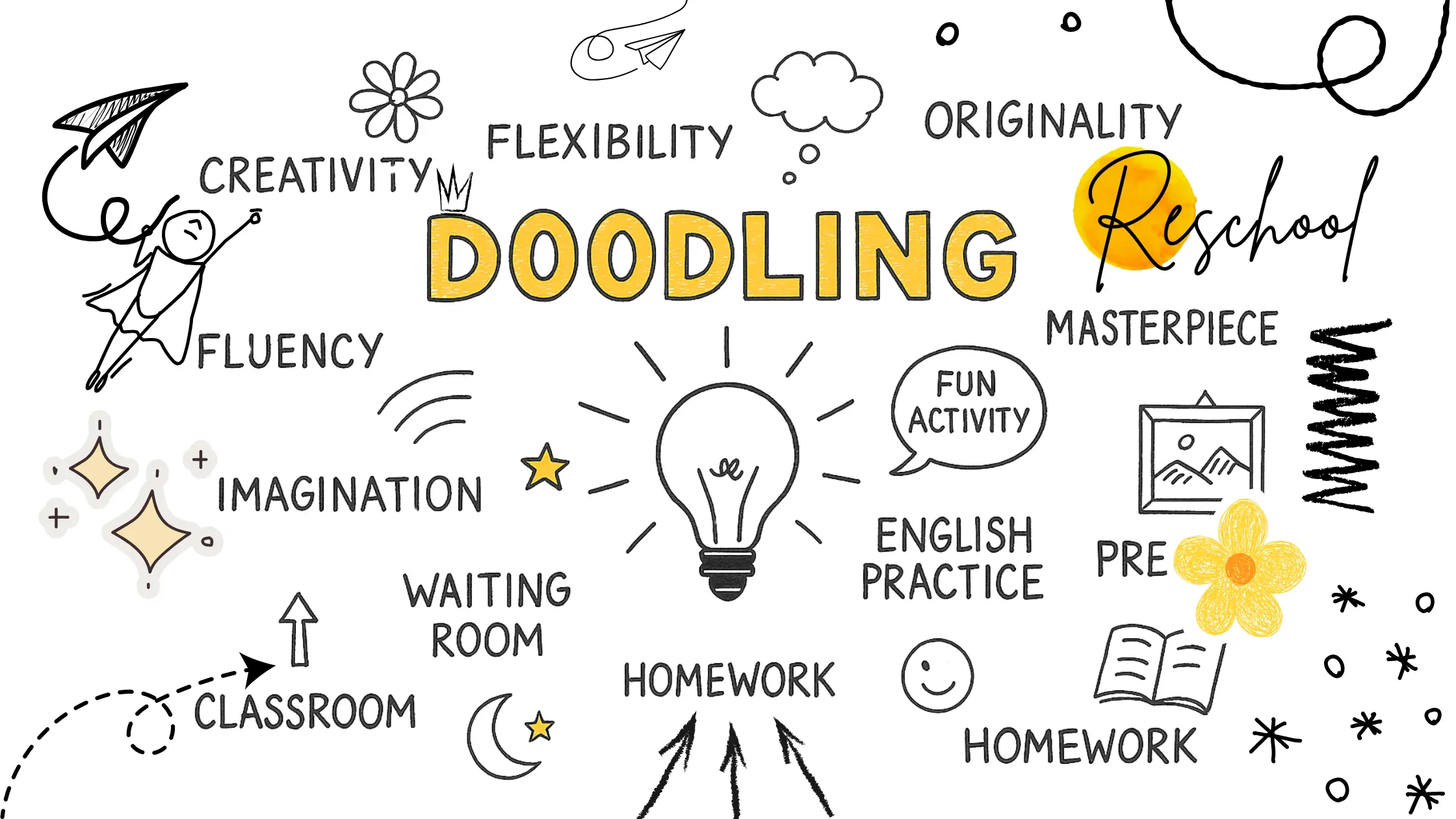
- Fluency: how many ideas they can generate, how effortlessly their creativity flows.
- Flexibility: whether they can shift perspective, move beyond one path, and explore many.
- Originality: the courage to stand out, to dare something “different.”
- Elaboration: how they nurture an idea, adding detail and care until it becomes a masterpiece.
💡 How to bring it into your classroom
- On the board: Draw lots of doodles with a marker. Ask each student to choose one and complete it.
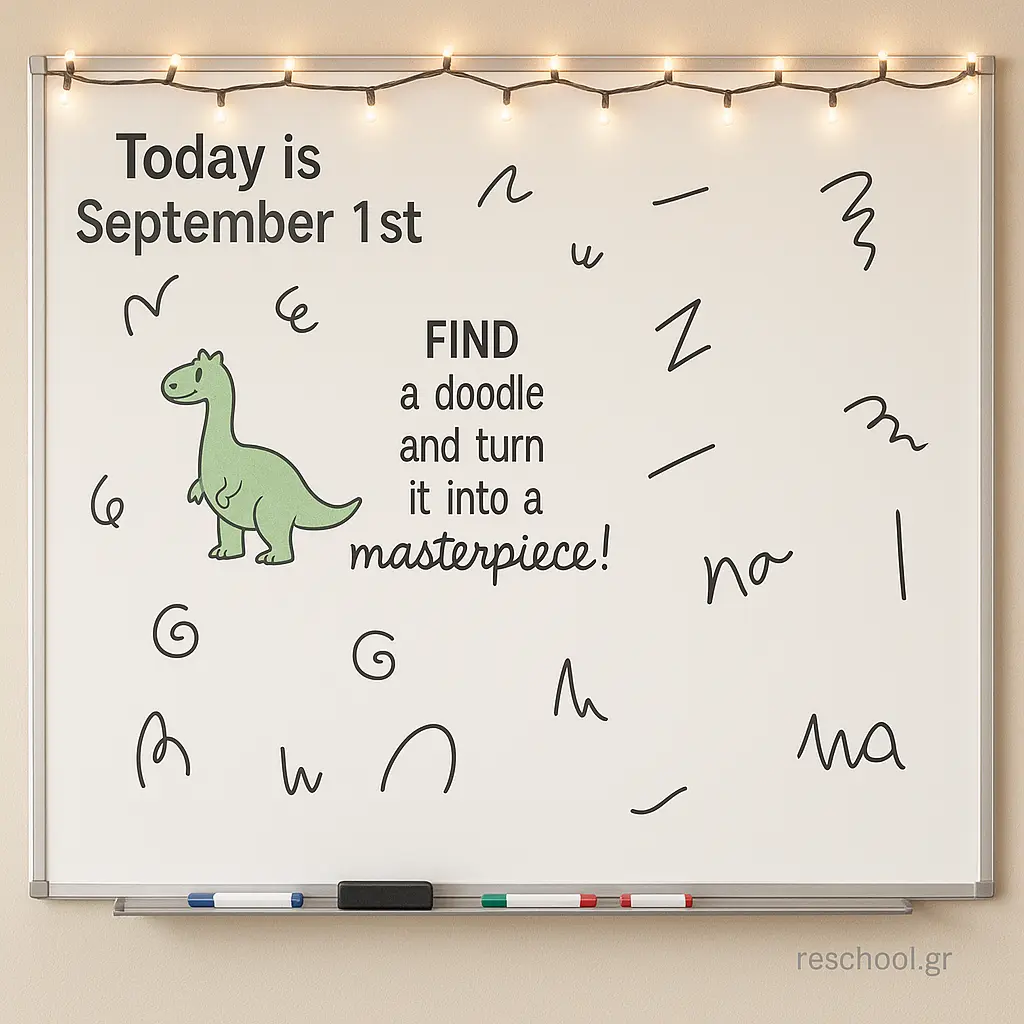
- On A4 sheets: Give each student their own doodle. At the end, all papers come together into a “wall of creativity”: a wallpaper of imagination. I’ve even prepared printable worksheets for you! Υou’ll find them here!
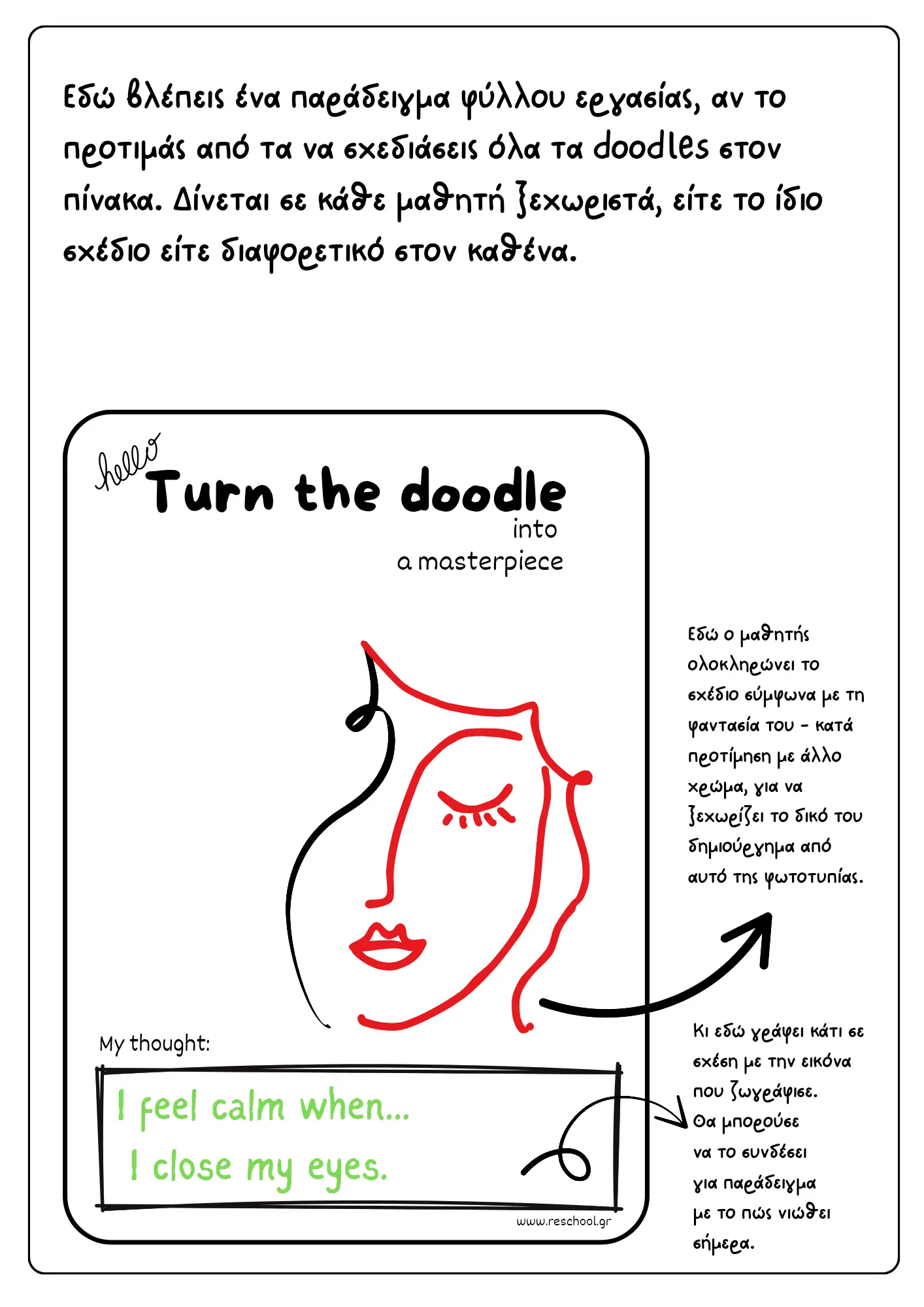
- Language connection: Ask each child to write a short phrase in English under their drawing.
👉 Example:
- A child turns a spiral into a snail and writes: “This snail carries my ideas slowly but surely.”
- Another transforms a curve into an airplane and writes: “My dreams can fly anywhere.”
This way, the doodle is not just an image, but also a message.
I first borrowed this idea from creativity tests for gifted children but it also works as an equalizer for students with learning difficulties.
🔹 Why is it an “equalizer”?
- There isn’t one right answer
In language (grammar, spelling), there’s often right/wrong → children with difficulties feel disadvantaged.
In creativity tests, every answer has value → the “funny” or “silly” idea counts just as much as the “serious” one.
- Imagination is valued over memory
Gifted students can throw out complex, imaginative ideas.
Struggling students, who may find reading/writing hard, can shine with a visual or verbal idea — no perfect grammar required.
- A level playing field
A child with dyslexia might draw or say a wonderful new use for a spoon (“It’s a microphone”) → and the whole class applauds.
The gifted child might give 10 ideas, but that one unique answer is equally precious.
- Atmosphere of acceptance
In these tasks, “crazy” and “imaginative” are positives.
Children who usually hear “wrong” now hear “great idea!” → self-esteem rises.
🔹 What does this mean in the language classroom?
- Gifted children may use more advanced vocabulary (“I’d transform the brick into a futuristic robot”).
- Children with difficulties can give simple answers (“It’s a chair”) and still fully join the game.
- The teacher can build on each answer → scaffolding: “It’s a chair.” → “Great! Can you say: It can be a chair for my doll?”
In this way, even the simple becomes rich without the child ever feeling “less.”
🔹 Psychological benefits
- Gifted students release their creative energy and don’t get bored.
- Students with difficulties don’t get left behind, because participation relies on imagination, not spelling or rules.
- The class develops a culture of acceptance: everyone has something to bring.
✨ Why it matters
- In the classroom
- In the waiting room
- Even as homework
This activity acts as a mirror of the soul.
It shows us how a child thinks, how they face the “incomplete,” and how they transform emptiness into creation.
Because creativity is not just a skill.
It’s the way a child says:
“This is me. This is how I see the world.”
👉 Your doodle project could be the warmest, most inspiring first activity of the school year.
Because you’re not asking children to write correctly, but to imagine freely.
Wishing you a wonderful summer,
Sophia & the Reschool team