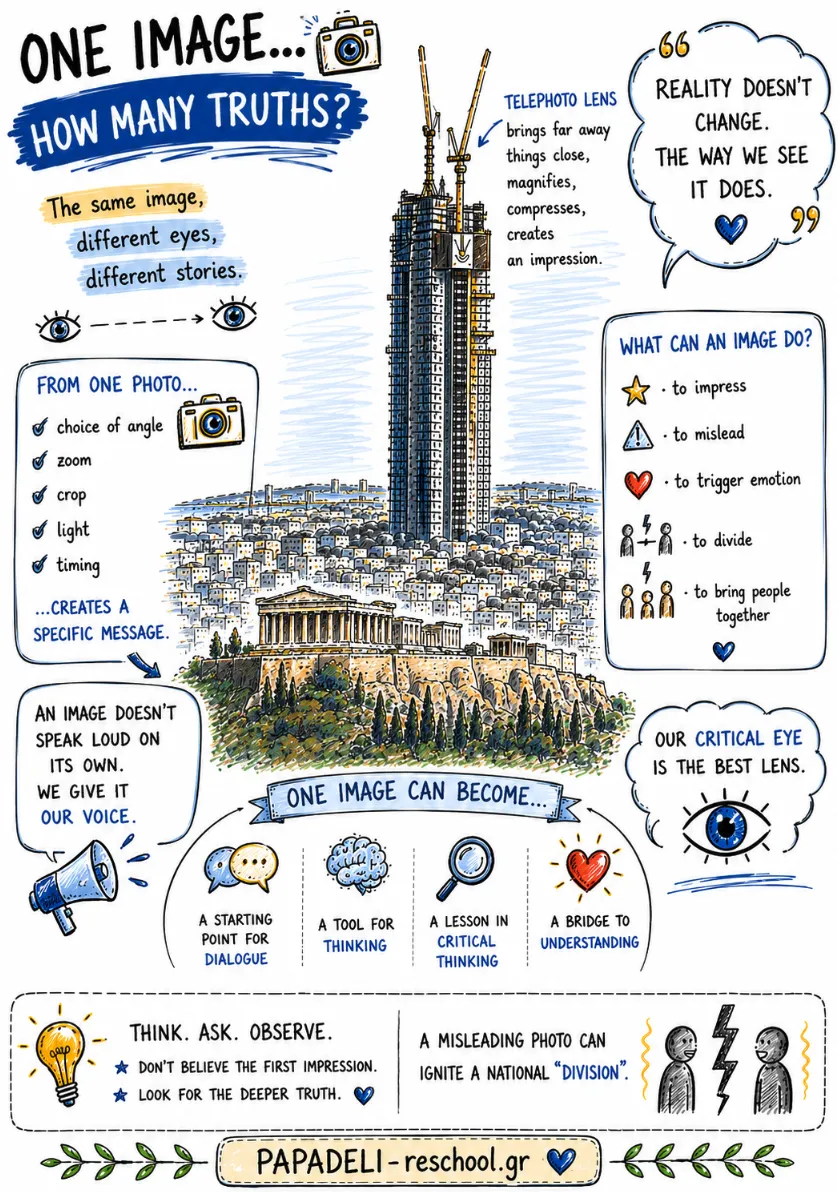
This photo divided Greece. And perhaps not without reason.
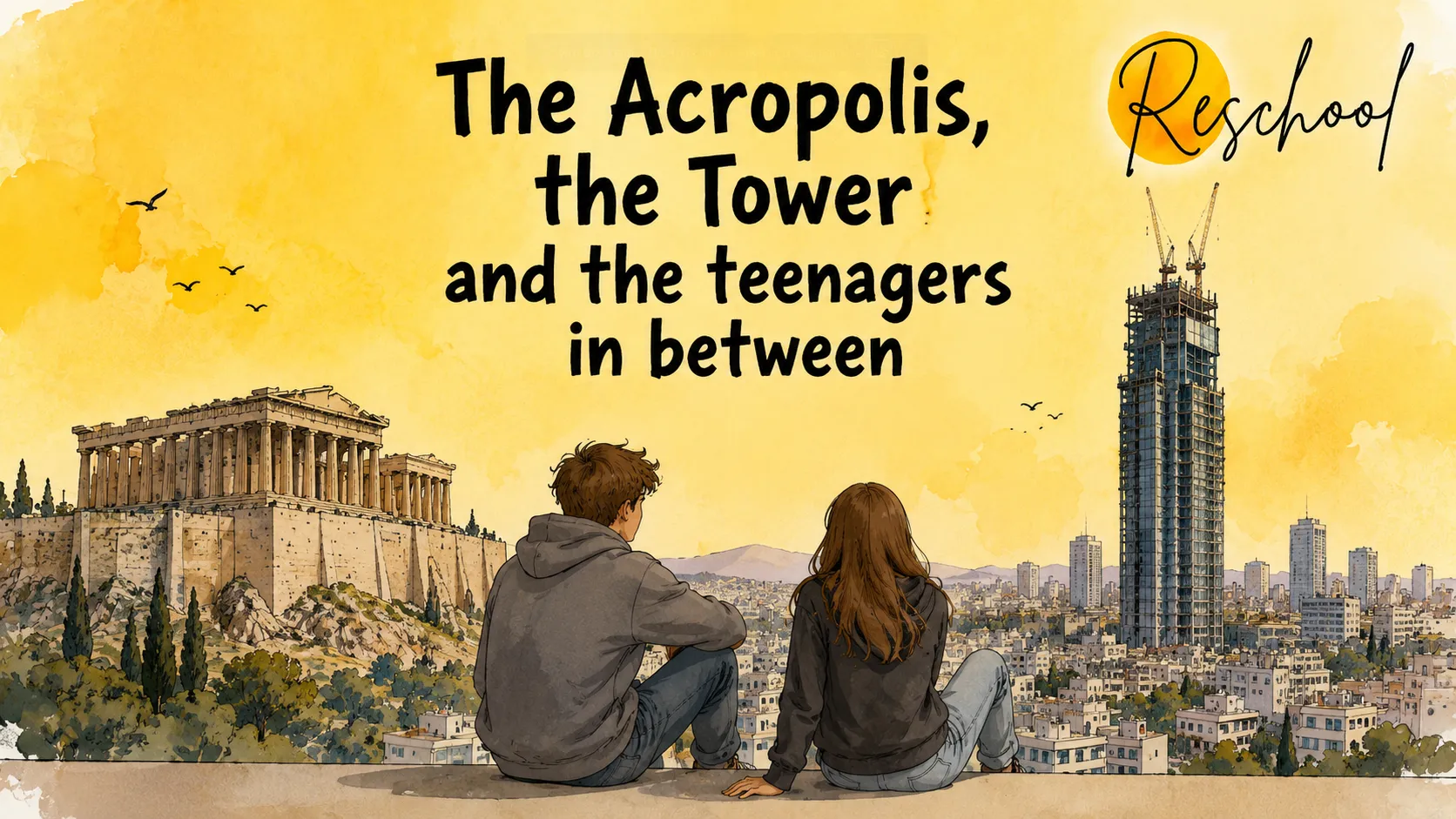
With these thoughts in mind, I walked into the classroom without saying a word. I simply projected this image onto the board and stood there silently for a few moments, almost as if I were waiting for the image itself to teach the lesson.
The Acropolis in the foreground. And behind it, the under-construction Rivie, looking as though it had emerged from another era, like a fragment of the future forced violently into a painting of ancient history.
For fifteen seconds, nobody spoke. And inside a teenage classroom, that is almost supernatural. Only eyes staring. Some curious. Some irritated. Some carrying that particular expression teenagers have when something unsettles them, even though they cannot yet explain why.
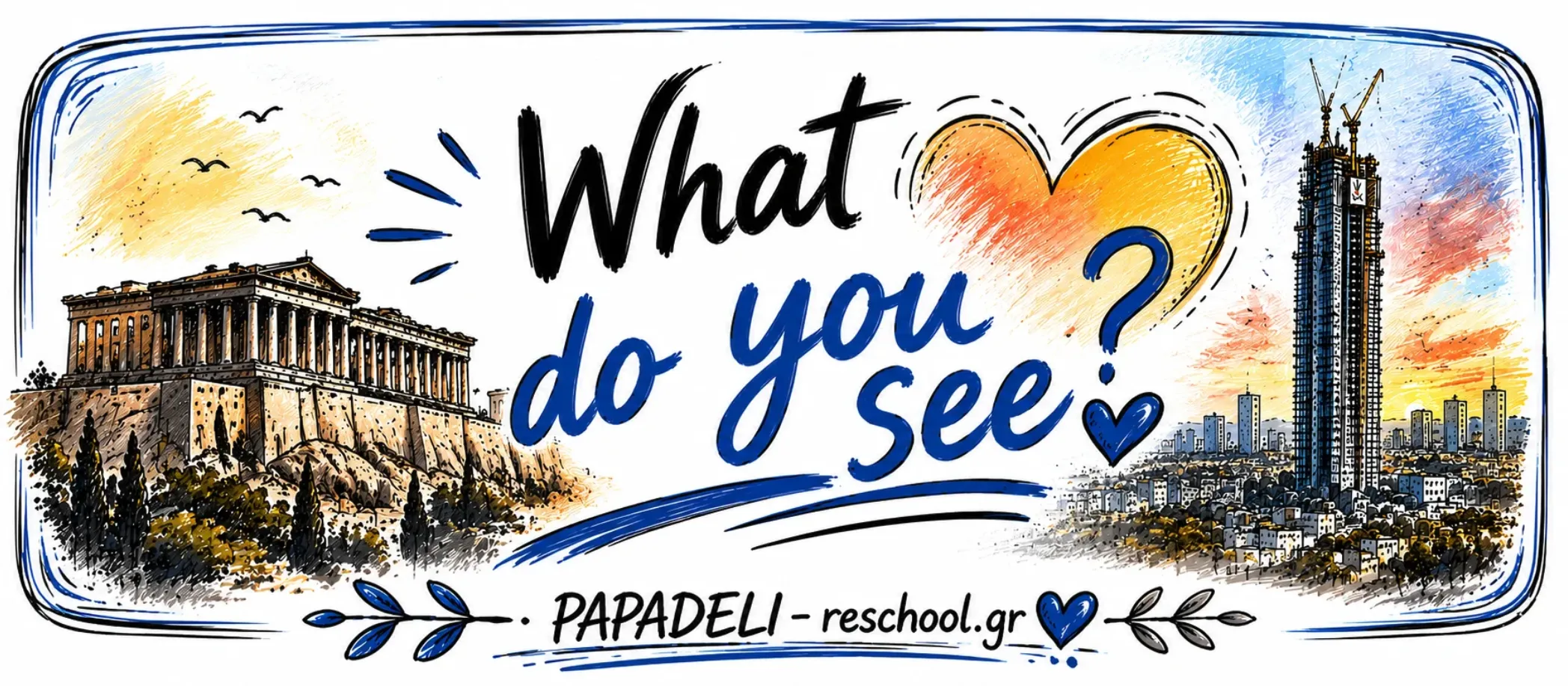
Then I simply asked them to tell me what they saw. And suddenly, it was not just words unfolding in the room, but entire ways of thinking.
-
Some said they saw progress.
-
Others saw invasion.
-
Some saw a “European Athens.”
-
Others saw a city slowly beginning to lose its voice beneath the weight of concrete and height.
Then I asked them something more difficult.

“How does this image make you feel?”
And that was the moment the atmosphere changed. Because suddenly the conversation moved away from buildings and straight into human emotion.
-
One student said the image made him feel proud because Athens finally looked modern. Another said it felt as though someone had raised an enormous voice behind a whisper thousands of years old, “a loud voice behind another one that was fading away.”
-
Someone else said the skyscraper looked as though it were trying to win a competition of height against something that never needed to become tall in order to become eternal.
-
Then one student said something I will never forget:
-
“The Acropolis is like my grandmother, Miss. She may not run faster than everyone else… but when she speaks, everybody falls silent.”
And once again I realised something we so often forget about children: They are not afraid of deep thoughts. They are simply tired of superficial questions.

After that, we split into two groups.
-
One defended the skyscraper as a symbol of development, economy, a new era, a Greece trying to lift its head and look higher.
-
The other defended the identity of Athens, arguing that some cities are not built only with cranes but also with memory; that certain landscapes carry so much history that you must approach them almost with reverence, the way you approach an elderly person who has seen far more than you ever have.
And the most beautiful part was this: They were speaking honestly because they felt the image belonged to them.
Later, I asked them whether they believed the skyscraper was truly as close to the Acropolis as it appeared. And from there, we entered another discussion entirely: about lenses, camera angles, perspective distortion, and the way an image can manipulate emotion without saying a single word. About how social media often does not simply show reality. It constructs a new version of it: more dramatic, more emotional, more viral.
And finally, I asked them:
“If the Acropolis could speak, what would it say to the Tower?”
And the answers began.
-
“I survived centuries. You may survive only an era.”
-
“I did not come to erase you. I came because people still build when they dream.”
-
“You may be taller. But I taught humanity what civilisation means.”
-
“And you may have taught them civilisation, but I remind them what ambition means.”
-
“I am not afraid of your height. I am afraid people may forget why I exist.”
-
“Perhaps the city needs both of us. You to remember… and me to dream.”
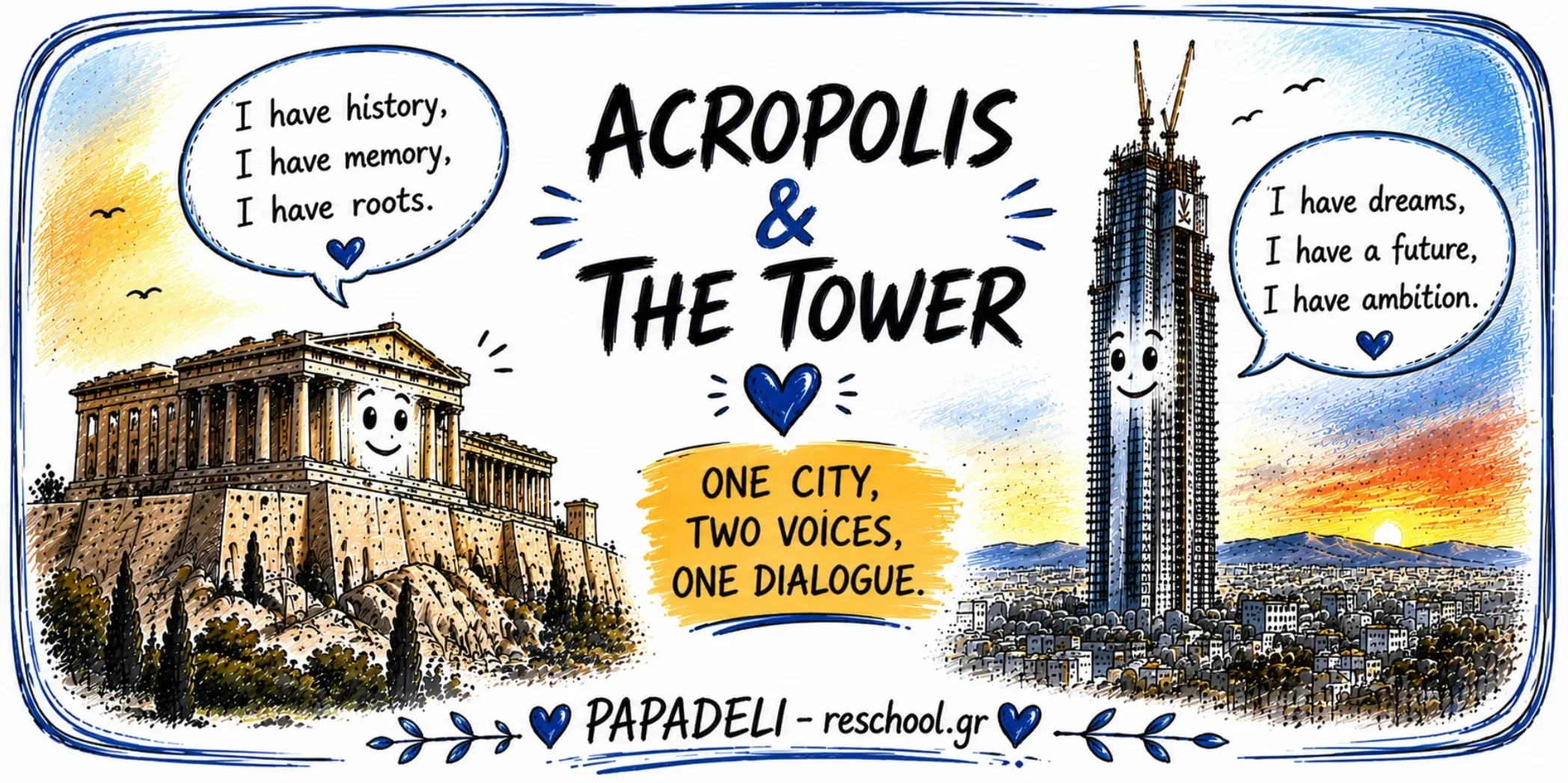
At that point, there was no longer just a photograph on the board. There was a dialogue between the past and the future. Between a city that remembers and a city rushing to change. It was as though Athens itself were standing in front of those students, asking them what they wish to preserve… and what they are willing to sacrifice in order to move forward.

And you? What do you see in this image?
A tower swallowing the Acropolis… or a skyscraper that already feels temporary beside it?