How many times does a child struggle to find the words to explain how they feel… and we wait for them to explain it And yet, they already have. Not with words. With their body. The body doesn’t wait to learn grammar. It doesn’t search for the “right phrasing.” It speaks directly. And if we learn to listen… we will understand children before they even speak.
When a child learns to recognize their body:
✔ they stop being afraid of what they feel
✔ they gain words for something that once felt “confusing”
✔ they begin to trust themselves
This is based on the connection between body and emotion. Research shows that emotions appear in the body first, before they take shape as thoughts or words. When we help children observe their body, we are essentially helping them understand and regulate their inner world. And what I’m about to say is not something new. It is a simple, timeless technique I often use when a child feels “something”… but cannot explain it. I don’t pressure them to find the right words. I don’t correct them. I don’t rush them to “calm down.”
I don’t ask:
👉 “What are you feeling?”
Instead…
👉 “Where do you feel it?”
Children don’t always say it… but they show it. They won’t always say “I feel ashamed.” They will lower their eyes. They won’t always say “I’m scared.” They will tighten their chest. They won’t say “I’m angry.” Their head will feel like it’s “boiling.” And they won’t say “I’m sad”… they will feel a lump in their throat. This changes everything -at school and at home.
Every emotion has its place. Not everything is “in the mind.” Emotions have space. They have a location. They live in the body.
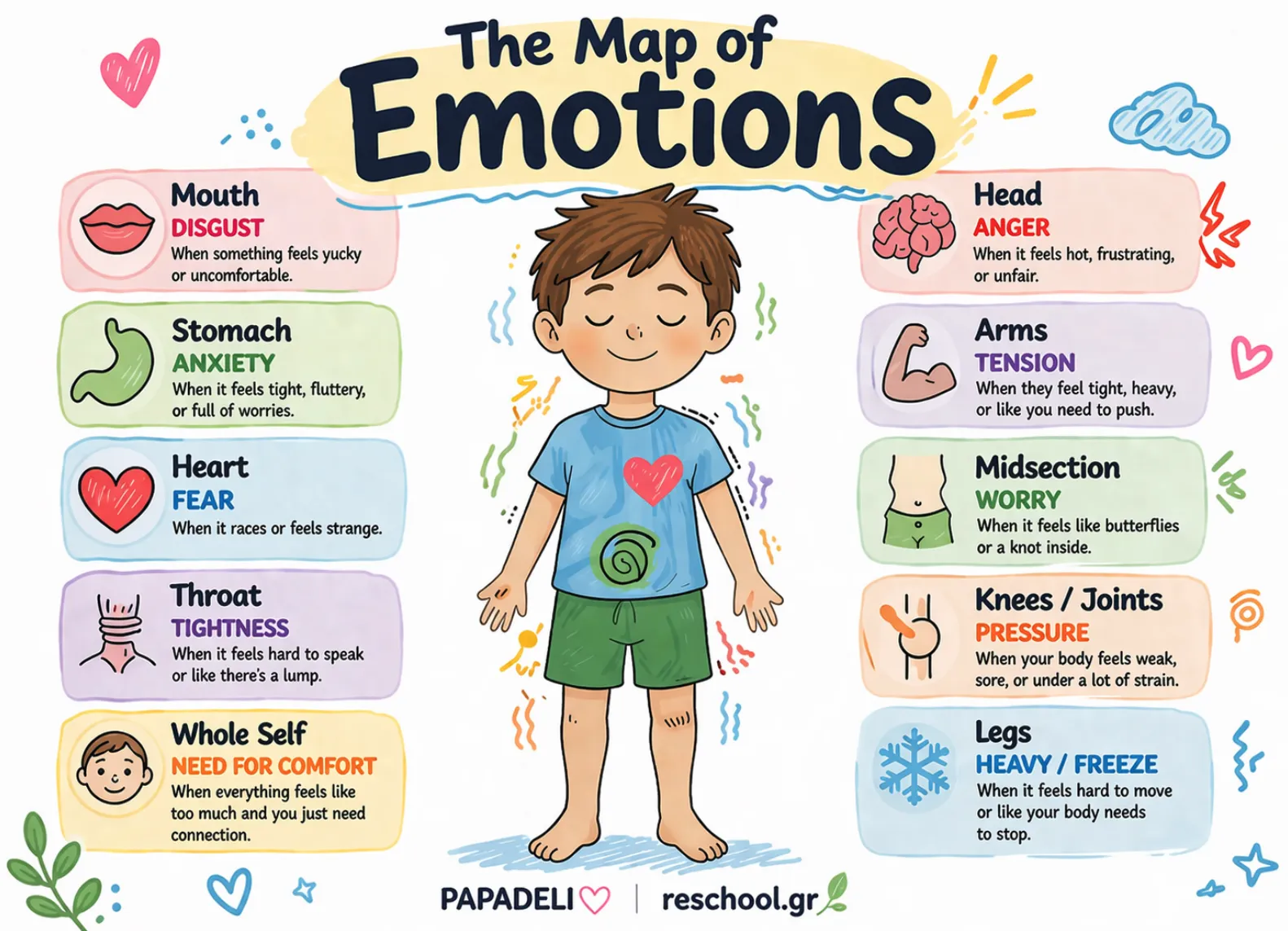
✨ If you feel it in your mouth → it’s disgust
✨ If you feel it in your stomach → it’s anxiety… or intuition
👉 If you feel it in your lower back → it’s insecurity / lack of support
✨ If you feel it in your chest → it’s fear
✨ If you feel it in your head → it’s anger
✨ If you feel it in your muscles → it’s tension / stress
✨ If you feel it in your face → it’s shame
✨ If you feel it in your throat → it’s sadness
✨ If you feel numbness in your neck or joints → it’s freeze (when something is too much for you)
The same place, of course, can tell different stories. A child holding their stomach might be afraid. But they might also “know” something without being able to explain it. That is intuition. Not all tension is fear. Not all tears are weakness.
✨ If you feel it in your mouth (disgust)
👉 say “I don’t like this”
👉 move away
✨ If you feel it in your stomach (anxiety / intuition)
👉 place your hand on your belly
👉 take 3 slow breaths
👉 ask: “Is this fear, or is something telling me to be careful?”
✨ If you feel it in your lower back (insecurity / lack of support)
👉 straighten your posture
👉 place your hand on your lower back
👉 lean on something (chair, wall)
👉 say: “I’m not alone. I can ask for help.”
✨ If you feel it in your chest (fear)
👉 hug yourself
👉 take deep breaths
👉 say: “I am safe right now.”
✨ If you feel it in your throat (sadness)
👉 talk to someone
👉 or allow yourself to cry
✨ If you feel it in your face (shame)
👉 gently lift your gaze
👉 say: “It’s OK to make mistakes.”
✨ If you feel it in your head (anger)
👉 take space
👉 count to 10
👉 move your body
✨ If you feel it in your muscles (tension)
👉 tense and release your body
👉 stretch your arms and legs
✨ If you feel it in your neck / joints (pressure)
👉 roll your shoulders
👉 take a short break
✨ If you feel numb (freeze)
👉 gently move your fingers
👉 press your feet into the ground
👉 name 3 things you can see
Children don’t need to be taught “not to feel.” They need to be taught to understand what they feel. Because when a child understands their emotion, they are no longer afraid of it And when they are not afraid… they can manage it.
And yes… this applies to us adults too. What you feel is not random. It is a message. And when you learn to listen to it… you learn to listen to yourself.
The most powerful question we can ask a child is:
👉 “Where do you feel it?”
Because in that moment, we are not looking for the right answer.
We are looking for a way to connect.
👉 “You don’t have to put it into words if you can’t.”
(removes pressure)
👉 “I’m here with you.”
(creates safety)
👉 “Can you show me where you feel it?”
(brings it to the body)
👉 “What you feel has a reason.”
(validates the emotion)
👉 “Let’s help it together.”
(creates cooperation)
👉 “You are not alone. I’m here with you.”
(builds connection)
👉 “Shall we take a small breath together?”
(regulation without command)
👉 “It will pass… and I’m here until it does.”
(provides stability)
💛 THE MOST IMPORTANT THING
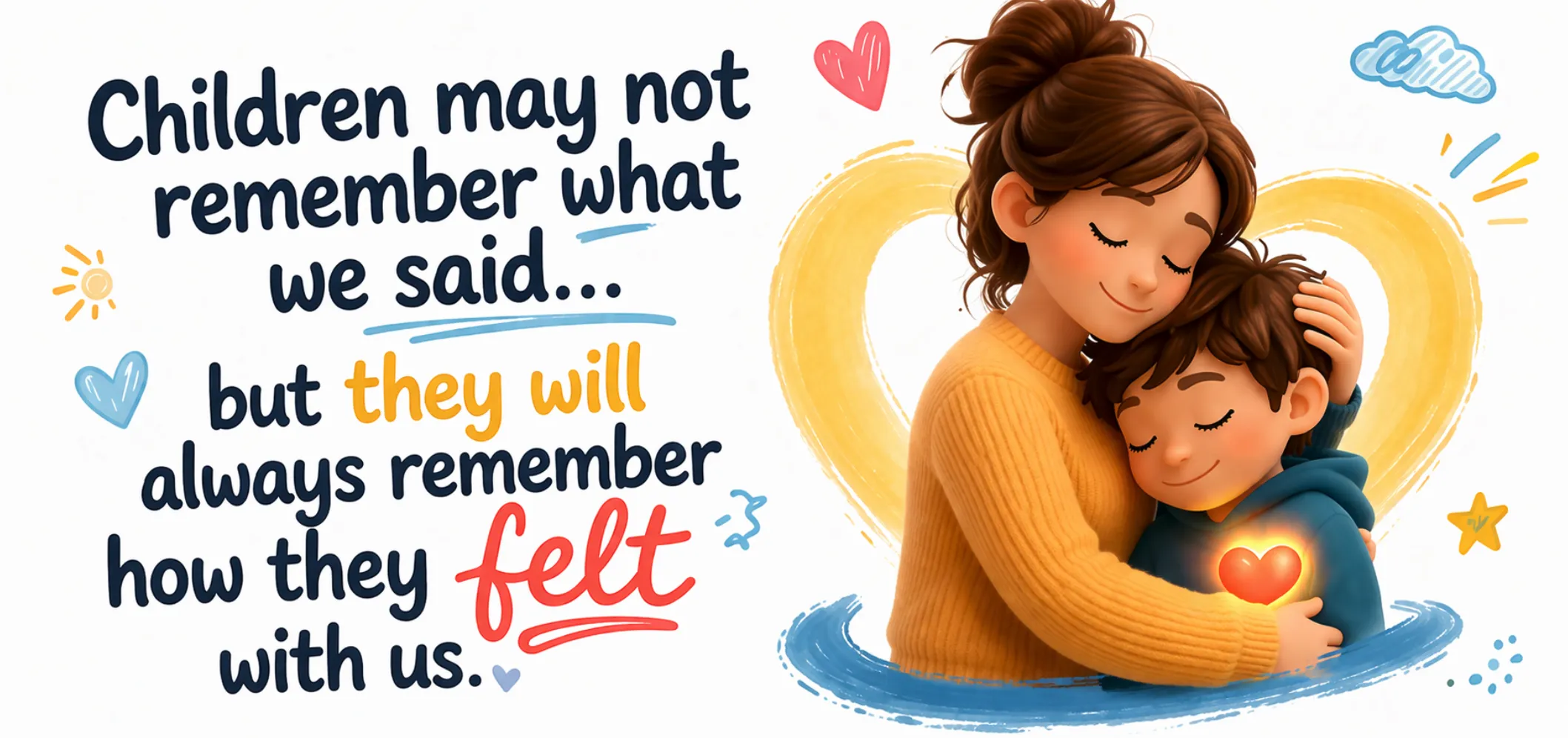
We don’t need to say the “right words.” We just need to be present in the right way.
✍️ If this article resonated with you, share it with a parent or a teacher. It might change the way they see a child… forever.
Papadeli Sophia
🌐 www.reschool.gr